

Normal Barium Enema
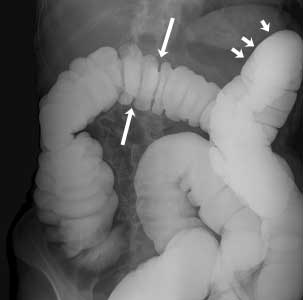
Courtesy of Intermountain Medical Imaging, Boise, Idaho. All rights reserved.
This image shows a normal colon filled with barium. The barium shows up as white on the image. The arrows point to the normal curves of the colon.
Why is a barium enema test done?
A barium enema is done to:
- Find swelling of the intestinal wall that occurs in inflammatory bowel diseases. Examples are ulcerative colitis and Crohn's disease. A barium enema also may be used to keep track of the progress of these diseases.
- Find problems with the structure of the large intestine. Problems may include narrowed areas (strictures) or pockets or sacs (diverticula) in the intestinal wall.
- Help correct a condition called ileocolic intussusception. This occurs when the end of a child's small intestine protrudes into the large intestine.
- Check on belly symptoms such as pain, blood in stool, or altered bowel habits.
- Check on other problems such as anemia or unexplained weight loss.
How is a barium enema test done?
During the test
The colon is filled with a contrast material that contains barium so that the colon can be seen on an X-ray. This is done by pouring the contrast material through a tube inserted into the anus. The barium blocks X-rays, causing the barium-filled colon to show up clearly on the X-ray picture.
- You will lie on the X-ray table while the first X-ray film is taken.
- While you are lying on your side, a well-lubricated enema tube will be inserted gently into your rectum. The barium contrast material is then allowed to flow slowly into your colon.
- A small balloon on the enema tip may be filled with air to help you hold in the barium. Tightening your anal sphincter muscle (as if you were trying to hold back a bowel movement) against the tube may help. Taking slow, deep breaths may also help.
- You may be given a shot of medicine to relieve the cramping.
Your doctor will watch the flow of the barium through your colon on an X-ray fluoroscope monitor that is like a TV screen.
- You will be asked to turn to different positions (sides, front, and back). The table may be tilted slightly to help the barium flow through your colon and to take X-rays from different directions.
- Your doctor may also press gently on your belly with his or her hand or a plastic paddle. This can help move the barium through your intestines.
- If a double-contrast study is being done, the barium will be drained out and your colon will be filled with air.
A single-contrast study usually takes 30 to 45 minutes. But the actual time the barium is held inside is only 10 to 15 minutes. A double- or air-contrast study may take up to an hour.
After the test
When the test is finished:
- The enema tube is removed.
- You will be given a bedpan or be taken to the toilet to get rid of as much of the barium as you can.
- One or two more X-ray pictures (post-evacuation films) will then be taken.
After the test, you may go back to your regular diet unless your doctor gives you other instructions. Be sure to drink plenty of liquids. They replace those you have lost, and they help flush the remaining barium out of your system. Your bowel movements may look white or pinkish for 1 to 2 days after the test. Your doctor may tell you to take a medicine, such as a laxative, to help you pass the rest of the barium.
How do you prepare for a barium enema test?
- For 1 to 3 days before the test, you will drink water, fruit juices, plain coffee or tea, and broth.
- On the day before the test:
- Drink plenty of fluids. If you have kidney, heart, or liver disease and have to limit fluids, talk with your doctor before you increase the amount of fluids you drink.
- You will take a laxative. Your doctor will give you this to empty your intestines.
- You may be asked to do a water enema to clean your colon. You may need to do this again on the day of the test.
Before a barium enema, tell your doctor if you:
- Are or think you may be pregnant.
- Are allergic to latex. Latex products are often used to give the barium. If you are allergic to latex, different products will be used.
- Are allergic to barium.
- Have had an upper digestive barium test (upper GI or barium swallow) recently.
After the test, you may have light-colored stools and cramping for a few days.
What do the results of a barium enema test mean?
The results of a barium enema are usually ready right after the test or within a few days.
Normal: | The colon looks normal. |
|---|---|
Abnormal: | One or more problems in the colon are found, such as:
|
Many conditions can change barium enema test results. Your doctor will discuss any important abnormal results with you in relation to your symptoms and past health.
©2011-2026 Healthwise, Incorporated