
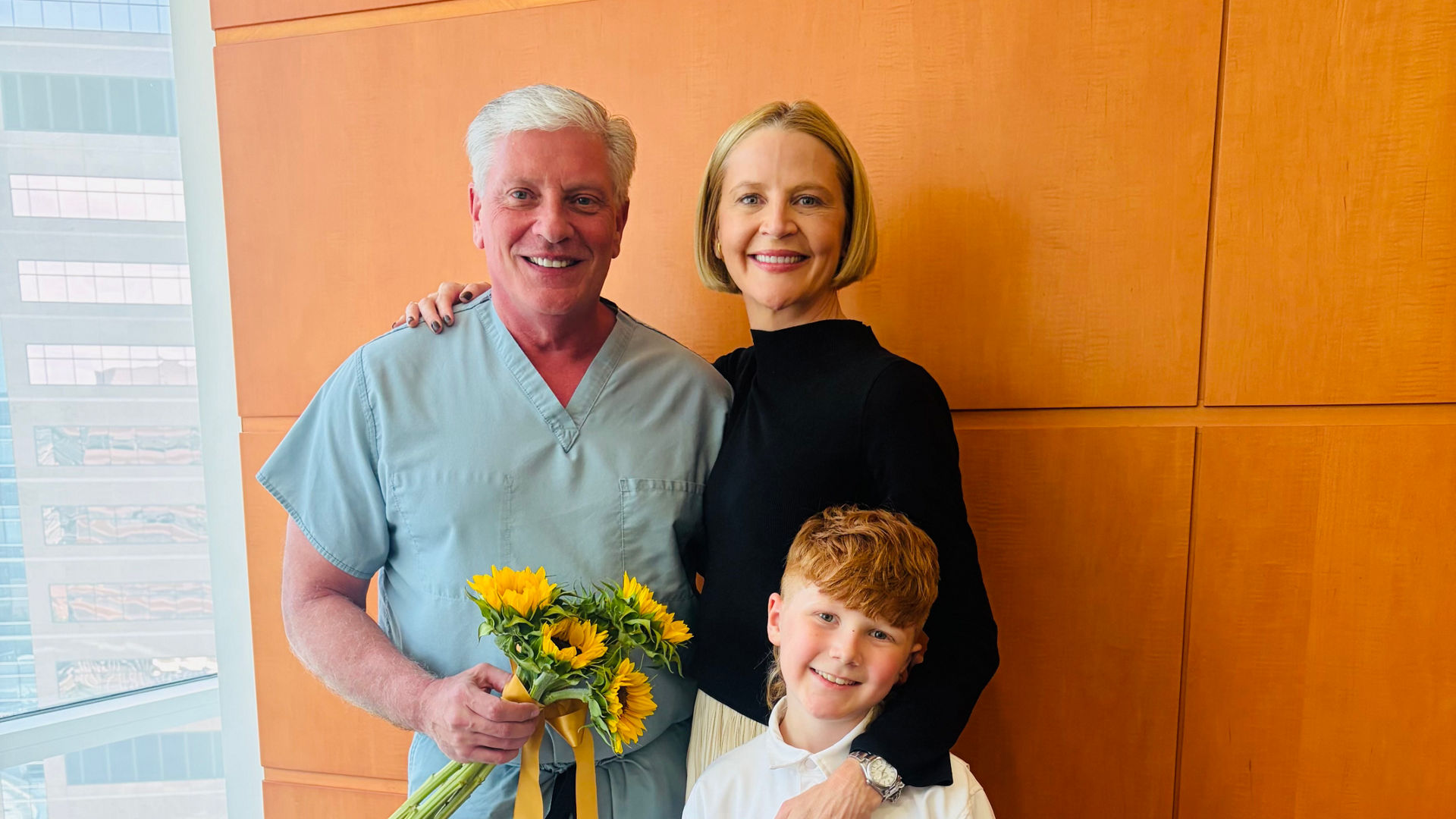
By Elizabeth Hardcastle, Baylor St. Luke’s Transplant Patient
I am sharing something personal because silence is part of why liver disease is often not understood until it’s too late.
At 41 years old, I never imagined I would need a liver transplant.
What should have been an idyllic day turned out to be anything but. The moment I realized something was wrong began while whale watching with my mother and son in Victoria, Canada. I started experiencing abdominal pain unlike anything I had ever felt before, and soon after noticed jaundice appearing in my eyes. Something was clearly wrong.
The next day, we returned by ferry to Seattle, Washington, and I immediately went to the emergency room. Doctors told me my liver was in very bad shape. My bilirubin levels were dangerously high, and the signs were starting to show in my eyes and skin. At the time, I didn’t fully understand what that meant. “Stop drinking?” That part seemed simple enough in my case. But no one had yet said the words “liver failure,” and I don’t think I grasped the seriousness of what was happening to my body.
After trying to finish out a couple more weeks of the trip, I headed home and went to our local emergency room. My hemoglobin was dangerously low, and I felt generally unwell, exhausted, and weak. But that hospital didn’t have a liver transplant team, and it quickly became clear that I needed specialized care.
After a long hospital stay with little progress, we made a difficult decision: we checked out and headed to Baylor St. Luke’s Medical Center.
That decision saved my life.
At Baylor St. Luke’s, everything changed. There were countless tests, exams, consultations and evaluations. It was overwhelming and frightening, but for the first time, I felt like there was a path forward. My battle suddenly had a chance. I was approved to be placed on the transplant list.
Oddly enough, I didn’t want to go home. I felt safest at Baylor St. Luke’s — or at least as safe as someone can feel during the most uncertain time of their life.
Before all of this, I never truly understood how important the liver is, what it does, or how damaging alcohol can be — but I was learning about it now, and it was all too real.
Looking back, I can clearly see signs of illness in my face and body for years before my diagnosis — bloating in my face and abdomen, easy bruising, spider angiomas appearing on my skin, and weight loss that I didn’t recognize for what it was at the time. I explained it all away as stress, aging or simply life moving too fast.
I spent seven months on the transplant list.
Twice, I was called in for a transplant that ultimately didn’t happen. At the time, those moments felt crushing. But in retrospect, everything happened exactly when it was supposed to.
And when the right liver finally came, so did my second chance at life.
I am fortunate to be part of an incredible community. Friends and family rallied around me in ways I will never forget. Together, they suggested we choose the St. Luke’s Foundation Liver Transplant Program as the beneficiary for our annual Halloween party.
In my first six months of recovery, we raised $16,200. It meant more than the number itself. It represented gratitude, connection and a way to give back to the place that saved my life.
Before the event, I mentioned the fundraiser to my doctor and asked something I had been wondering: Why don’t you hear more about liver disease and transplant stories? I’ve never personally come across a fundraiser for one.
His response stuck with me. He said, “It’s not exactly ‘En Vogue’ to talk about it.”
That line stayed with me. Because if people don’t talk about it, then it stays hidden. And if it stays hidden, people don’t get the chance to truly grasp it — or see themselves in it.
So I’ve decided to talk about it.
Every day, through marketing and media, we are quietly told that alcohol belongs in every part of life — celebrations, stress, reward and escape. The message is constant: alcohol is the answer.
What I’ve come to understand is this: we have to let our bodies simply be. You do not need alcohol to make you fun, relaxed or present. Everything that makes people love you is already there without it.
Learn more about the compassionate care offered at Baylor St. Luke’s Medical Center.
Facilities and providers


For employees and providers
About CommonSpirit
- Our story
- Our leaders
- Investor resources
- News
- Health blog
- Careers We're hiring!